Showing posts with label french bread. Show all posts

Sunday, 12 January 2014

EZ DOH Spelt Country French Bread

I just got a new bread-baking tool!  It’s called the EZ DOH manual bread dough maker and it was created by Gina, The Loaf Lady!  Her marketing manager (aka husband) sent me one of the units, and I’ve been having fun testing it.

EZDOH-14


I enjoy making breads by hand. Although I have a basic stand mixer, I don’t use it very often. I prefer to use my Danish dough whisk to mix the dough and then knead it by hand.

The EZ DOH takes things a step further by incorporating a dough hook that you crank by hand. This allows you to enjoy the hands-on experience, with less fuss, and less cleanup because everything can be done in the bucket; from mixing, to kneading, to proofing the dough. And did I mention, the EZ DOH maker is made in the USA and it’s BPA-free.

I started my testing with an adapted version of the basic French Bread recipe included with the unit. My version is made with all-purpose Spelt and whole grain Spelt flour. I also adjusted the hydration since Spelt absorbs water differently than all-purpose flour.


SPELT Country French Bread

Adapted from: EZ DOH Basic French/Italian Bread Recipe by www.EZDOH.com

Makes: 1 Loaf

This basic loaf is made using the straight dough method.  It works well if you want to make a quick loaf for a weeknight meal.

Spelt Country French Bread mixed in EZ DOH manual bread maker

Ingredients:

  • 1 1/8 cups water, more if needed
  • 1 T. olive oil
  • 2 1/2 cups all-purpose white Spelt flour, plus additional for dusting
  • 1/2 cup whole grain Spelt flour
  • 2 1/4 tsp. instant yeast
  • 1 T. sugar
  • 1 tsp. salt

Mixing the dough:

The instructions on the unit suggest that you add the warm water first, and sprinkle the yeast over the top of the water. Then add the rest of the ingredients, in the order listed.

I use instant yeast and it isn’t necessary to activate the yeast so I added all of the dry ingredients (like I normally do) and then mixed in the wet ingredients. However, doing it this way made it a bit tricky to get all of the dry ingredients incorporated. Next time, I’ll add the wet ingredients first and place the dry ingredients on top.

I found that it helped to hold back some of the water and add the rest after I had started mixing the dough. You may need to incorporate more flour or water to achieve the desired dough consistency just as you would with any bread dough.

The EZ DOH mixes the dough fairly quickly.  Start by turning the handle in one direction and mix. Then switch directions and continue  mixing and alternating directions until all of the dry ingredients are incorporated into the dough.  The total mixing time is about 2-5 minutes.

spelt-country-french-bread_104 spelt-country-french-bread_107


After I finished mixing, I removed the crank assembly and worked the dough just a bit with my hands to make sure it was the right consistency. I have to get my hands on the dough no matter what tool I use.

Bulk Fermentation:

Let the dough bulk ferment in the bucket until it is doubled in size, about 30-45 minutes.   I let this dough ferment for about an hour.

spelt-country-french-bread_109 spelt-country-french-bread_111


Shaping the Loaf:

Because this loaf includes olive oil, and whole grain flour, my version is more like a country loaf than a baguette. You can shape the loaf into the traditional French baguette shape, but I shaped my loaf into a round boule.

I placed the shaped boule on parchment paper sprinkled with spelt flour. You can use cornmeal for sprinkling, but I wanted a pure Spelt loaf.

Cover the loaf with plastic wrap or a kitchen towel and let it proof until doubled in size, about 20-30 minutes, (or longer) depending on the temperature in your kitchen.

spelt-country-french-bread_113 spelt-country-french-bread_114


Preparing the Loaf for Baking:

Preheat the oven to 425 degrees F. with a baking stone on the bottom rack and an iron skillet or steam pan on the top rack.

Score the loaf in the pattern of your choice, using a serrated knife or bread lame. I used a straight-edged lame to score a square (sort of) around the top of the loaf. You might need to sprinkle the top of the loaf with a little flour so to make scoring a little bit easier.

spelt-country-french-bread_121 spelt-country-french-bread_118


Baking the Loaf:

Using a baker’s peel or the back of a baking sheet, slide the bread (on the parchment paper) onto the preheated stone. Carefully add a few ice cubes to the preheated iron skillet or steam pan. Spritz the loaf with water and immediately close the door and turn the oven down to 400 degrees F. Bake the loaf for 20 to 25 minutes, or until it is golden brown. 

Remove the loaf to a wire rack to cool before slicing and serving. The loaf tastes best warm, but it will cut more easily if you allow it to cool before slicing.

Spelt Country French Bread mixed in EZ DOH


The basic recipe is easily adaptable to other types of bread. The pamphlet included with the EZ DOH unit provides several options and is a good starting point for making a variety of different types of breads. The savory garlic rolls sound divine and the sweet rolls… Yum! I wanted to try all of the variations, but I refrained because I also wanted to find out what other types of dough it could handle.

For my next test, I’ll be making whole wheat bread using an overnight sponge. Look for more information about that bread in an upcoming post.


Happy Baking!

Cathy


Saturday, 10 November 2012

French Bread with Apples & Walnuts

The theme for the November Twelve Loaves’ challenge is apples. I had a few apples left from my excursion to my favorite farm in October so this was a good excuse to use them. 

I decided to make French Bread with Apples and Walnuts because it sounded really good, but also because the dough is prepared the day ahead in the bread machine and then placed in the refrigerator to ferment overnight. The bread machine did the mixing and kneading so this gave me time to do other things – mainly make more bread.

french-bread-apples-walnuts0009


Although I reduced the number of mixing bowls and clean up required for this bread, I still managed to mess up almost every single mixing bowl in my house this weekend. I fed all of my starters, created a soaker and rye sourdough for a different bread and recreated my Einkorn starter that bit the dust. All in all, it was a good bread-baking weekend. All for the love of bread, right?


TWELVE LOAVES_thumb


The dough for this French bread is made with white bread flour for the most part, but it also includes a little bit of whole wheat flour.  I’m trying to use up some of the extra flours and grains in my freezer so I substituted Teff flour for the whole wheat flour.  I also used unstrained natural apple cider rather than the sparkling apple cider the original recipe called for.  I’m sure the sparkling cider would have been good, but I had the natural cider so I used it instead.


French Bread with Apples and Walnuts

Adapted from: Rustic European Breads from Your Bread Machine by Linda West Eckhardt and Diana Collingwood Butts

Makes: One 1 1/2-pound Loaf

Ingredients:

  • 3 cups bread flour
  • 1/2 cup Teff flour
  • 2 teaspoons bread machine yeast
  • 1 teaspoon salt
  • 1 1/2 cups natural apple cider (unstrained)
  • 1 large or 2 small cooking apples (enough for 1 cup)
  • 1/3 cup coarsely chopped walnuts


Directions:

Step 1: Add the flours, yeast, salt, and cider to the bread machine pan in the order specified by the manufacturer. My bread machine specifies that you should add the liquid first, then the flour and salt and then make a well in the center for the yeast. The salt shouldn’t come in contact with the yeast. Process it on the dough setting until it is well mixed and kneaded.  This will take about 20 to 30 minutes in most bread machines.

french-bread-apples-walnuts01


Step 2: Remove the pan from the bread machine, cover the dough (in the bread machine pan) with plastic wrap, and put it in the refrigerator overnight or for at least 8 hours.  This will allow the dough to rise slowly.

french-bread-apples-walnuts04


Step 3: Take the dough out of the refrigerator and allow it warm up to room temperature for about 2 hours.

french-bread-apples-walnuts003


Step 4: Remove the dough to a lightly floured work surface and knead it lightly to remove air bubbles. Let it rest on the work surface for 5 minutes.

french-bread-apples-walnuts005


Step 5: Chop the apples.  While the dough is resting, peel, core and finely chop the apples and coarsely chop the walnuts (if necessary).

french-bread-apples-walnuts006


Step 6: Knead the apple and walnuts into the dough. Knead until the apples and walnuts are evenly distributed throughout the dough.  It takes a little while (5 minutes or so) to get them evenly distributed so be patient.  Keep lightly dusting the work surface as needed to keep the dough from sticking.

french-bread-apples-walnuts008


Step 7: Bulk Fermentation. Shape the dough into a ball. Place it in a lightly greased bowl, cover it with plastic and let it rise in a warm draft-free place until doubled in bulk, about 2 hours.

french-bread-apples-walnuts012


Step 8: Shape and proof the dough. Remove the dough from the bowl and shape it into a round ball (or boule). Place the dough on a wooden peel dusted with cornmeal or a baking sheet lined with parchment paper.  Or, you can use a floured banneton basket as I did.  Cover it again with plastic wrap and let it rise again until it doubles in size, about 1 1/2 hours.

french-bread-apples-walnuts016


Step 9: Preheat the Oven. About 30 minutes before you plan to bake the bread, preheat the oven to 450 degrees F. with a baking stone (or tiles) on the middle rack and a steam pan on the bottom rack.


Step 10: Remove the loaf from the basket. Carefully remove the loaf from the proofing basket onto a baking sheet lined with parchment paper.

french-bread-apples-walnuts018


Step 11: Score the Loaf.  Using a sharp knife, serrated knife, or lame, score the top of the loaf in a tic-tac-toe pattern using slashes that are 1/4 inch deep. I made my slashes a little deeper than 1/4 inch.

french-bread-apples-walnuts025


Step 12: Bake the loaf.  Slide the loaf (on the parchment paper) on to the preheated baking stone.  Fill the steam pan with 1 cup of hot water.  Then spray the oven walls with a few squirts of water from a spray bottle.  Close the oven door.  Repeat this process two more times during the first 10 minutes of baking. Bake the loaf for 15 minutes, then reduce the heat to 400 degrees F. and bake for an additional 20 to 30 minutes, or until the loaf is a rich, dark brown and the crust is firm.  The loaf should sound hollow when thumped on the bottom.


Step 13: Cool the loaf.  Remove the loaf and let it cool completely on a wire rack before slicing or serving.

french-bread-apples-walnuts00022


Step 14: Slice and Enjoy! This bread tastes great warm with butter, but it also tastes great with the apple butter I made a few weeks ago.  It has an interesting flavor and texture due to the apple cider, chopped apples and the teff flour. I like it!

french-bread-apples-walnuts0005


Thanks to Lora of Cake Duchess, Jamie of Life’s a Feast, and Barb of Creative Culinary for hosting the Twelve Loaves challenge.


Happy Baking!

Cathy

Tuesday, 28 August 2012

Pain Francais in Honor of Julia Child

This month, the Bread Baking Babes and Buddies are honoring Julia Child who would’ve been 100 years old on August 15th. In memory of this remarkable woman, the BBBs have been baking Julia’s version of Pain Français (French Bread) from her book Mastering the Art of French Cooking, Volume Two.

Julia Child was very detailed and thorough which I appreciate being a detail-oriented person myself.  Her process for making this bread is presented in 20 pages of meticulous directions. Even though I appreciate Julia’s thoroughness, I was delighted that Susan of Wild Yeast simplified the process for us by summarizing the formula and condensing the instructions. 

French-Bread10


This French Bread takes about 7 –10 hours from start-to-finish so dedicating that amount of time will take a little bit of planning, but it’s definitely worth the effort. I followed Susan’s summary for the most part, but deviated on the kneading process and the bulk fermentation because as usual, I was trying to cram too much into my day off and ran out of time. I’m sure you never do that, right!


Pain Français (French Bread)

From: Mastering the Art of French Cooking, Volume Two by Julia Childs

Makes:

  • 3 baguettes or batards or boules
  • Or 6 short loaves (ficelles)
  • Or 12 rolls (petits pains)

Process:

I followed the ingredients and mixing instructions from Julia Child’s French Bread — Recipe Summary by Susan at Wild Yeast.

I deviated from the instructions at the kneading phase. Instead of kneading the dough for 5 – 10 minutes, I used the method from Tartine Bread by Chad Robertson. With this method, you do a series of turns in the bowl during the bulk fermentation to develop the dough structure.

Refer to my Tartine Country Bread post for a step-by-step photo tutorial on this method.

For the first 3 hours, I turned the dough every 45 minutes.  Then I deflated the dough and let it rise for another 1 1/2 hours.

French-Bread007
Dough after the initial mixing.
French-Bread010
Dough after a couple of hours and several turns.
French-Bread013
The deflated dough after 3 hours.
French-Bread016
Dough after an additional 1 1/2 hours.  The structure is really developed now.
French-Bread017
Dough divided into 3 pieces and resting on the counter before shaping.
French-Bread021
Shape the balls into baguettes and place on Baker’s couche to proof.
French-Bread018
I placed the loaves in the refrigerator at this point because I had somewhere I was supposed to be.
French-Bread024
The next day, I took the loaves out of the refrigerator, let them warm up to room temperature, and gently transferred them to a parchment-lined baking sheet.
French-Bread026
I scored the loaves using my Scaritech lame.
French-Bread027
The loaves are covered with plastic and resting while the oven is preheating.
French-Bread029
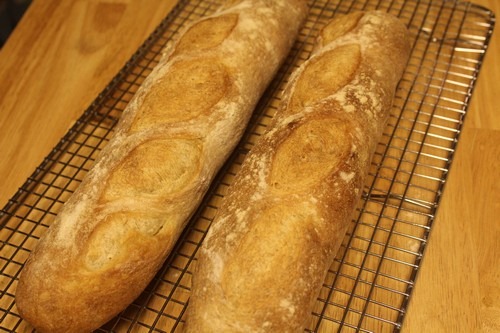
Baked loaves cooling on a wire rack.
French-Bread051
Baked loaves ready to slice & serve.


I sliced one of my loaves lengthwise because I wanted to see how it would taste as sandwich bread.

French-Bread09


I made egg salad sandwiches and served them with homemade kosher pickles. It was a pretty chewy sandwich but good nonetheless.

French-Bread0004


I think this French Bread might be better suited as an accompaniment to some delicious soup.  I’ll try that next!  


Happy Baking!

Cathy

Tuesday, 31 July 2012

Straight Baguettes for Bread Baking Day #52

The theme for Bread Baking Day (BBD) #52 is French Breads. I’m glad Cindy of CindyStarblog chose this theme because I’ve had these baguettes on my list to bake for several weeks. I wanted to continue my baguette-making journey and this provided another opportunity… not that I need any motivation to bake bread.

I’ve been out-of-town on business so my issue was finding the time to actually make them. I finally got the opportunity to bake bread this weekend. It felt so good.

baguettes06

These straight baguettes are really easy. They can be made the same day. It usually takes about 5 hours from start to finish. They don’t even require an overnight poolish or Pâte Fermentée. If you want to serve baguettes for dinner, and have a few hours, this could be a good option.

I started making these baguettes Sunday afternoon, but ran out of steam before I could finish so I retarded the dough in the refrigerator overnight.

The next day, I let the dough warm up to room temperature for a couple of hours and then shaped, proofed and baked the baguettes.

I suppose officially this version wouldn’t be considered a straight baguette, but this process worked better with my schedule and energy level.


Straight Baguettes

Adapted from: The Fundamental Techniques of Classic Bread Baking by The French Culinary Institute

Makes: 2 Baguettes

Ingredients:

  • 383 g (~3 cups) bread flour, plus extra for dusting
  • 284 g (~1 1/4 cups) water
  • 2 g (3/4 tsp) instant yeast
  • 7 g (1 tsp) salt


Directions:

1. Mix the bread flour and water until thoroughly blended.  You can use an electric stand mixer fitted with a dough hook and mix on low speed, but this dough really doesn’t need a mixer.  I used a Danish dough whisk.

2. Let the dough autolyse (rest) for 15 minutes. Then add the salt and yeast and mix until thoroughly blended. The resting period helps the gluten structure start to develop. If necessary, add a little extra water to help dissolve the salt and yeast.

3. Scrap dough into the bowl. Don’t add any additional flour, just scrap the wet dough (using a dough scraper or a wooden spoon) into a large greased bowl. Cover the bowl with plastic wrap and let the dough rest for 20 minutes.

4. Fold the Dough. Uncover the dough, fold it, then cover it back with plastic wrap and let it rest another 20 minutes. Repeat this process and let the dough rest an additional 20 minutes.

5. Final Fold. Uncover the dough again and fold it, then cover it with plastic, but this time let it bulk ferment for 2 hours. I let mine bulk ferment for about an hour or so, then placed it in the refrigerator overnight.

baguettes002 baguettes004
baguettes007 baguettes010

6. Preheat the oven to 450 degrees F. about an hour before you plan to bake the baguettes.  If you are using a baking stone, place it in the oven to preheat along with a steam pan underneath.  I decided to use my baguette pan for these loaves so I didn’t use the baking stone, just the steam pan.

7. Form the dough into rough logs. Uncover the dough and form 2 logs on a lightly floured, clean work surface.  Mist them lightly with spray oil and cover them with plastic wrap.  Let them rest for 15 minutes.

8. Shape the logs into batards. Begin by gently pressing on the dough to degas it. Shape it into a rough rectangle.

Fold the top of the dough down and seal it with you fingers to degas it somewhat. Then fold the lower section of the dough up and seal it with your fingers. You’ll end up with a rough batard-shaped loaf.  This is the seam side up view.

9. Shape into Baguettes. Turn the dough seam side down and using cupped hands, roll the dough back and forth from the middle out, to extend the dough into the shape of a baguette.

baguettes011 baguettes013
baguettes014 baguettes015
baguettes012 baguettes016


10. Proof the Loaves. Place the loaves seam side down on a baker’s couche or baguette pan. Cover again with plastic wrap and let them proof for 30 minutes.

11. Score the Loaves. Uncover the dough, then use a lame or razor to score the loaves for baguettes. I made the French cut version, where you make about 4 or 5 vertical, but slightly angled slashes in the dough starting at the top left of the loaf and ending at the bottom right.  The slashes should overlap about an inch or so.

baguettes020 baguettes023

12. Bake the Loaves. Add 1 cup of ice to the steam pan in the preheated oven and immediately transfer the loaves onto a baking stone (if using) or place the baguette pan in the oven. Spritz the loaves with water and close the oven door. Repeat the spritzing a couple more times during the first few minutes, then close the door. Let the loaves bake for 25 minutes or until the crust is a deep golden-brown and the sides are firm when you touch them.

13. Cool the Loaves. Remove the loaves from the oven and transfer them to a wire rack to cool.

14. Slice and Enjoy!

baguettes042 baguettes19

This bread has been YeastSpotted.

I was pleased with the results and the flavor of these baguettes. I heard them crackle when I took them out of the oven and let them cool on the wire rack. I didn’t taste them until the next day, but they tasted good not blah like I expected from a baguette without a preferment. I had them with some organic butter. Yum!


Happy Baking!

Cathy


Bread Baking Day #52 - French Bread (last day of submission August 1st, 2012)


Thanks to Cindy for hosting Bread Baking Day #52

BreadBakingDay was created by Zorra of http://kochtopf.twoday.net/stories/4124192/.